Religion

Stand Up and Be Counted

by Alex on May 10, 2013

This Shabbat, we read the portion of the Torah called Bamidbar (Numbers 1:1-4:2).  In this section, the Israelites conduct a census of themselves.


Why do they count? (Besides the fact that God told them to).


Counting matters because it’s taking stock of what’s present.  And, more importantly, being counted signifies that one wishes to be included.    Allowing oneself to be counted means stepping forward to assert not only one’s rights but also to accept one’s responsibilities.


I think of this, as we approach Mother’s Day, for, if nothing else, it is mom who day in and day out steps forward to say, here I am, to be counted, and to take on the full range of duties that she has signed up for.


So, here’s to moms everywhere for standing up and being counted.


{ 0 comments }

These Chitlins’ Ain’t Kosher

by Alex on March 29, 2013


As night falls and the Shabbat (the Sabbath/day of rest) begins, we take time to rest and reflect and consider this week’s parshah (section of the Torah) — Shemini (Leviticus 9:1–11:47 of the Bible).


In this week’s parshah, among other things, we read about God handing down the kosher laws — or, as one might say “these chitlins’ ain’t kosher.”


Here are a few other things that aren’t kosher:


1. Kim and Kanye’s decision to name their child “North” West.


2. Republican policies on immigration; social welfare benefits; global warming and gun control


3. Donald Trump’s hair


4. Fox and Friends


5. Guilt-trips


6. North Korea’s dictatorship


7. Wal-Mart’s employment practices


8. John Boehner’s skin color


9. Anything said by Jamie Dimon and/or J.P. Morgan’s leadership


10. Charlie Sheen’s insides


 Here, our son, Ivan, demonstrates consumption of a kosher (though not kosher-for-Passover) biscuit
Here, our son, Ivan, demonstrates consumption of a kosher (though not kosher-for-Passover) biscuit

{ 0 comments }

Passover

by Alex on March 25, 2013


Tonight marks the beginning of Passover — the holiday commemorating the Israelites Exodus from Egypt.  Jewish people around the world will celebrate by conducting a Seder (a ritual meal in which the story of the Exodus is re-told).  During the Seder, it falls to the youngest child present to ask the Four Questions (in fact, there are 5, which includes an introductory question, which is perhaps the most famous of all of them):


Why is this night different from all other nights?

On all other nights we eat leavened products and matzah, and on this night only matzah.

On all other nights we eat all vegetables, and on this night only bitter herbs.

On all other nights, we don’t dip our food even once, and on this night we dip twice.

On all other nights we eat sitting or reclining, and on this night we only recline.


However, what few people know is that are an additional 10 questions that get asked by the parents at the table:


Why don’t you call?

What did you do with your hair?

When are you going to get married?

When are you going to have children?

Why don’t you get a better job?

Why don’t you help your brother/sister get a better job?

Why don’t you visit more often?

How could you say such a thing?

How was the traffic getting here?

Could you look at my computer, I think something is wrong with it.


Happy Passover everyone!  And, don’t forget to watch the Ten Commandments!

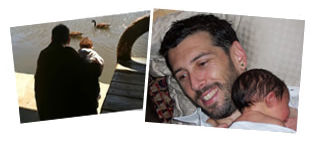
Our son, Ivan, and me reading the Four Questions for Passover and keeping count with crayons. Our son, Ivan, and me reading the Four Questions for Passover and keeping count with crayons.

{ 0 comments }

The 10 Commandments of Parenting

by Alex on March 22, 2013

This Monday marks the beginning of Passover. The holiday marks the Jewish people’s Exodus from Egypt and re-establishment of Judaism, including receipt of the 10 Commandments.


As we prepare for this holiday, it occurred to me that just as God gave the Jewish people 10 Commandments, Parents give their kids 10 Commandments as well.  And, as with the original 10 Commandments, there are 5 positive ones and 5 negative ones:


Without further ado, here are the Parenting 10 Commandments:


Positive:

1. Come here

2. Wipe your nose

3. Wash your hands

4. Sit still

5. Give me that.


Negative:

6. Stop crying

7 Don’t touch that

8. Don’t stand on that

9. Don’t jump on that

10. Don’t hit


{ 0 comments }

Building the Home

by Alex on March 8, 2013

Tonight as Shabbat arrives, we relax and reflect as usual and turn our attention to this week’s Torah portion — Vayakhel Pekudei (Exodus 35:1–40:38 & 12:1–20).  In this “episode” Moses gathers the Israelites and reiterates to them the commandment to observe the Shabbat. He then relays Gods’s instructions regarding the making of the Tabernacle.


What do we make of this week’s portion?


Clearly it’s about building a home.  And, that’s what it’s all about.  Building a home.  So, this weekend, sit back, relax, reflect on how to build a home.  Here are a few suggestions:


1. separate beds for everyone – the family that sleeps well, tolerates each other reasonably well


2. earphones — if you can tune each other out, you don’t have to listen to someone else’s nonsense.


3. Netflix and/or Amazon Prime subscriptions — nothing beats family time except time alone with your favorite program while your loved ones watch their own favorite shows.


4. wine (for the adults) — self-explanatory


5.  age appropriate toys for the kids — again, self-explanatory.  An occupied and engaged child is a child who isn’t annoying.


6. chocolate — at some point, someone’s going to blow their stack.  And, generally, chocolate heals most if not all wounds


7. dad’s “cave” — if dad has his own space, everyone benefits.  If he doesn’t, then everyone’s going to hear — yet again — how dad is drawing “a line in the sand”


8. purell — let’s face it, family is dirty work.  Clean hands means clean not everyone has to get the latest thing going around 4th grade/work/everywhere


9. comfort food — weekends are about eating something comforting.  No one wants to eat cuttlefish with a balsamic reduction and then talk to their family.  Cuttlefish puts you on edge.  BTW — what’s cuttlefish?


10. At least one meal together — yep, everyone is annoying, but there is no substitute for family.  In the end, these are the folks that have your back.  So, sit down, shut up and eat.  You’ll be glad you did.


{ 0 comments }

As we welcome the Shabbat this Friday evening, we turn our attention to this week’s Torah portion — Ki Tisa (Exodus 30:11-34:35).  In this chapter, when Moses descends the mountain he finds that the people have built an idol, a Golden Calf, and Moses he just . . . well, he gets pretty angry and throws down the tablets containing the 10 Commandments and shatters them.


There’s more to the story, but that’s a major highlight.  What are we to make of it?


As a parent, I’d say that one meaning is that sometimes a tantrum isn’t just a tantrum. Often, at the core of many tantrums is often a nugget of meritorious argument.


I’m not saying we have to throw stuff down and smash it to bits to get people to pay attention to what’s important.  On the other hand, sometimes you have to communicate in such a way that you get people’s full and undivided.  Just remember, there’s a balance.


What do you think?


{ 0 comments }

If You Build It They Will Come

by Alex on February 15, 2013


Everyone knows the famous line from Field of Dreams: “If you build it, they will come.”  What fewer people know is that this concept appeared in popular culture way before the movie and Kevin Costner.


In this week’s Torah portion, Trumah, Exodus 25:1-27:19, God instructs the Israelites on how to build the Tabernacle or sanctuary in which will be housed the Ark (before it got lost and then raided in the first Indiana Jones movie).


Basically, the point of this section of Torah reading is “If you build it, they will come.”  Actually, because God was commanding it, the phrase was more like “You will build this, or else . . . . And, then they will come.”


As our 17-month old son, Ivan, and I sat and thought about this, we  wondered about this whole “if you build it, they will come” phenomenon.  Ivan saliently pointed out that it seemed a lot like Supply Side economics, a failed economic doctrine that President George H.W. Bush once derided as “Voodoo Economics.”


And, yet, we still cling to the romantic notions that if you take a risk, if you bet on faith, you will be rewarded.  (How else do you explain my continued and ongoing comedy career?)


Of course, “building it” isn’t always easy.  Building takes planning, diligence, and work, usually hard work.  Sometimes it’s fun, but often it’s not.  And, sometimes, there’s a lag between building and people coming.  It’s not always like Field of Dreams, where you build the thing and within a couple of weeks there a long line of cars down the highway all coming to see your efforts.  More often, you build, sometimes, in stages so incremental even you’re not quite sure when building is done.  And, then you wait.  And wait.  And wait. And, people don’t come.  And, you wait some more, and they still don’t come.  And, you wait a little longer, and they still don’t come.  And then, just when you’re ready to give up, one person comes.  And, then you don’t know if this is a harbinger of more people coming or just an outlier.


How do you know?


You don’t.


This is when you have to decide how much you’re committed to the thing you built.


And, that’s the test.  How committed  are you to what you’re building?  You won’t know unless you build it before they come.


Here, Ivan asks whether he can use his bowl and spoon to help “build it”

{ 0 comments }

A Foot for a Foot

by Alex on February 8, 2013

It’s Shabbat again — the Sabbath — a time to disconnect from all that technology, step into the company of friends and loved ones and relax and reflect.  This week, for those out there who are keeping up with their Torah reading, the portion being covered is Mishpatim (Exodus 21:1-24:18).  In last week’s episode, God presented the Ten Commandments.  This week, we see more laws and regulations being provided and promulgated, which no doubt caused the Republicans of that era to bemoan the era of Big God/Big Government.


Amongst the many rules provided (including how to treat one’s slaves . .  .oops, that’s not good), there are the famous words  ” . . . an eye for an eye, a tooth for a tooth, a hand for a hand, a foot for a foot, . . . .”


What does this mean?  Most have interpreted to mean essentially that an offense or crime should be met with like or proportionate punishment.  But, maybe there’s a deeper meaning.  Maybe it means when you display one foot you have to display the other


Nah . . . it means when everyone thinks it means.  So, whatever you do this weekend, don’t take someone’s eye or hand or foot, or, worse yet, their time, because they’ll turn around and do it to you.

{ 0 comments }

Parting the Red Sea

by Alex on January 25, 2013

Tonight marks the beginning of Shabbat, the Jewish Sabbath.  It is a time to step back from the usual routine of our daily lives, relax and reflect.  During Shabbat, we read a section of the Torah, called a Parshah.  This week’s section is from the Book of Exodus (13:17–17:16) and concerns the parting of the Red Sea as the Israelites flee from Egypt on their way towards what they hope will be deliverance.


What can we take from this today? Is it that if you run away from your problems solutions will present themselves?  Probably not.  It would be easy to say that, by contrast, it means if you seek out your goal a miraculous solution will present itself.  But, maybe that’s too easy.


Well, since I’m on the road, I’d like to think it’s a little bit about the good things that happen as you seek out your home.


Okay, yeah, it’s sappy, but I’m psyched to go home.


{ 0 comments }

Darkness Darkness Everywhere

by Alex on January 18, 2013


Tonight marks the beginning of Shabbat, the Jewish Sabbath.  It is a time to step back from the usual routine of our daily lives, relax and reflect.  During Shabbat, we read a section of the Torah, called a Parshah.  This week’s section is from the Book of Exodus (Exodus 10:1–13:16) and is called “Bo.”  It involves the last 3 of the plagues visited upon Egypt and Pharoah and the description of the first Passover.


As is widely known, the final plague was the killing of the firstborn of Egypt.  But, what you may not remember was that the 2d to last plague was “darkness.”


As we all know from childhood, darkness can be pretty terrifying.  And, at some point, each of us has to be comforted by a parent that we “shouldn’t be scared of the dark.”


That admonition is of little comfort to any child.  Frankly, if you ask most adults they’ll tell you they’re still scared of the dark.  The dark is filled with the unknown.  And, there is little more frightening than the unknown or the uncertain.


But, darkness doesn’t have to be all bad.  Darkness can bring with it a quiet and stillness.  It can be a time of great serenity and restfulness.  So, as we head into this Shabbat, I thought I’d take a whack at coming up with some positives about the dark so that when our son gets a little older, and he’s afraid of the dark (if he is), I’ll have something to comfort him with.   So here goes:


1.  If it’s dark outside, there’s a pretty good chance you’re not at work.


2. Darkness is very conducive sleeping.


3. The best way to watch a movie is in the dark


4. Darkness can hide all manner of sins, including, fat, unsightly lines, and a messy room


5. Darkness is a much better way to experience a hangover


6. Hanging out in the darkness will reduce your risks of sunburn and keeping the lights off will save on the electric bill


7. If you order a glass of scotch, people won’t ask you “why are you drinking at this hour?”


8. Contrary to popular belief, monsters do not like the dark either.  However, it remains unclear whether they like the closet and the space underneath the bed.  And absolutely keep your feet covered while in bed regardless of how hot it may be.


9. You can’t use that really cool “Black Light” in a lit room or in daylight.  Only darkness will do.


10. Darkness must be great.  Congress operates in the dark constantly, and they must be doing that for some reason.


{ 2 comments }

MY TAKE ON: